


By Alex I., Founder of Tektora
Editor’s Note
This is Episode 2 of “How to Start Your Own Microbrand,” Season 1: Tektora. This ongoing documentary series follows real founders building watch brands from scratch. No sponsorship, no sales pitches. Just the raw process, the real costs, and the lessons learned. MBWW has no financial relationship with Tektora or its founder. All editorial decisions are made independently by MBWW.
Missed Episode 1? Read The Spark & The Blueprint.
Have questions for Alex? Drop them in the comments. Are you a founder with a story to tell? Reach out to us for future seasons.

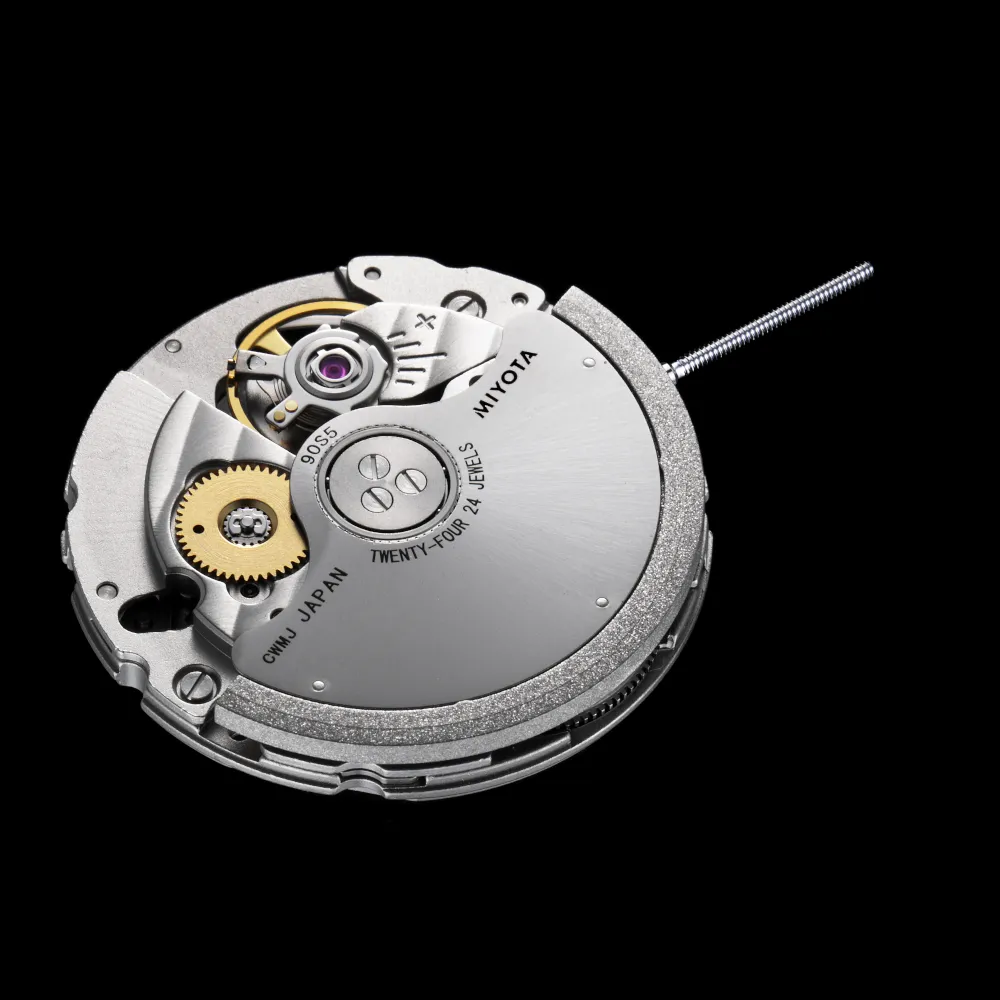
In Episode 1, I explained why the Miyota 90S5 was the right movement for this watch. Its high-beat rate, slim profile, and gilt decoration. Here, I want to go deeper: why the alternatives didn’t work, and why the 6 o’clock open-heart placement was worth the engineering headache.
The Movement Alternatives
I considered three movements before settling on the 90S5.
The Seiko NH35 is a workhorse. Reliable, affordable, and widely used. But it’s thick (over 5mm) and beats at a lower frequency (21,600 bph). It would have made the watch thicker and less smooth-sweeping. At 38mm with a multi-layer dial, every millimeter of case height matters.
The Sellita SW200 is a premium Swiss alternative. But it’s more expensive, arguably harder to source at 100 pieces, and lacks the gilt decoration that makes the 90S5 so visually appealing through the open heart. It would have pushed the price point significantly higher, which broke the value proposition I was aiming for.
The 90S5 was the right choice: thin (3.90mm), high-beat (28,800 bph), and designed to be seen. The gilt bridges catch light magnificently. The balance wheel is warm gold against the grey meteorite surface.
The 6 O’Clock Challenge
I wanted the open heart at 6 o’clock. Not the usual 5 o’clock.
Most brands choose the path of least resistance. They place the open heart wherever the movement naturally allows, and they’re done. I wanted something better.
That meant rotating the movement inside the case and repositioning the crown. The 90S5 presents its open-heart at 5 o’clock from the factory. To get it to 6 o’clock, the whole movement had to be rotated, which meant the crown couldn’t stay at 3 o’clock.
Most production partners told me it wasn’t worth the hassle for a 100-piece run. It took weeks of back-and-forth to get it right.
If you look at the case flank, you’ll notice the crown sits at 4 o’clock. That’s the tell. It’s not at 3. It’s offset. That asymmetry is physical proof that the movement was rotated.

Why does this matter?
Because the 90S5 is designed to be admired. The open heart is the kinetic star. Against the grey meteorite rock, it flashes like a warm, glowing heart inside a cosmic vault.
More on the engineering challenge of cutting an open heart into fragile meteorite, and why most brands avoid it, in Episode 4.

Why an Open Heart?
I’m aware of the polarizing nature of open hearts. They’re divisive. In some corners of the watch world, they’re dismissed as gimmicks. Cheap windows punched into cheap dials to distract from cheap movements.
That criticism is fair. But it’s aimed at the wrong target.
The problem isn’t the open heart. The problem is the lazy open heart: a low-beat movement with undecorated plates, a hole slapped at 9 o’clock because that’s where the factory template puts it, a “feature” that exists because the brand couldn’t think of anything better to do with the dial.
That’s not what this is.
The Miyota 90S5 is a true high-beat caliber with gilt-decorated bridges, engineered specifically for open-heart visibility.
The balance wheel is the soul of the machine. It beats 8 times per second. It converts the stored energy of a wound spring into the measured progression of time. That transformation is why mechanical watches still exist in a quartz world.
I wanted the open heart at 6 o’clock. Not because it was easy, but because that’s where it belongs.
At 6 o’clock, the open heart anchors the dial. It balances the applied Breguet numerals at 12. It creates vertical symmetry in a dial built on horizontal tension. The organic chaos of meteorite against the geometric precision of guilloche. The golden balance wheel becomes a counterweight: warm gold against cool grey, kinetic energy against static stone.
This open heart successfully preserves the dial’s visual real estate while celebrating the mechanics.
It’s intentional, not accidental.
Polarizing by Design
And that’s the point.
One of the hardest parts of designing a watch is accepting that you can’t please everyone. Every design decision eliminates a segment of potential buyers. The open heart is a perfect example. Some people love them, others despise them. There’s no middle ground.
I spent a long time worrying about this. I read forum threads where enthusiasts openly mocked open-heart watches as “gimmicky” or “entry-level.” I had moments of doubt, wondering if I had made a fundamental error. But I also noticed that the people who hated open hearts weren’t my target audience. They already owned a collection of safe, conventional watches. They weren’t looking for something unusual.
The people who were interested, the ones who reached out and asked questions, were different. They were curious about the meteorite dial. They were fascinated by the 6 o’clock placement. They wanted something they hadn’t seen before.
What I learned: Polarizing design choices will alienate some people, but they also build a stronger connection with the people who share your vision. The trade-off is real. You can’t build a watch that appeals to everyone. And if you try, you’ll end up with something that feels safe and forgettable. The people who love this watch will love it because it’s different. That’s the point.
Regulation and Testing

Each Miyota 90S5 is individually regulated and tested before assembly. Our workshop’s standard is -10 to +15 seconds per day, already tighter than Miyota’s factory specification of -10 to +30. At 28,800 vibrations per hour, that deviation is imperceptible in daily wear. The focus isn’t chasing chronometer certification; it’s ensuring every watch leaves the workshop running within a window that respects both the movement’s capabilities and the customer’s expectations.
The Case Engineering

The case is 316L stainless steel. 38mm, brushed lugs and case top, polished bezel and sides.
At that size, the case is large enough for presence, small enough for comfort. It fits a wide range of wrist sizes.
The ultra-slim profile (11mm) slips easily under cuffs. This is a genuine achievement when fitting a multi-layer meteorite dial into a compact case. The 90S5’s 3.90mm thickness is what makes this possible.
The mixed finishing signals quality. Sharp transitions, no soft blending. At this price point, mixed finishing is rare. Most watches avoid it to save cost. I didn’t want to compromise.


The Dial Opening

The dial opening is expansive at 32mm, compared to the standard 28-30mm at this price point. This gives the timepiece the visual presence of a larger watch, while maintaining the comfortable 38mm case size.
The result is a watch that wears larger than its dimensions suggest, but without the bulk.
Next Week: Episode 3 – The Business of Time. The financial realities of MOQs, supply chain coordination, and what it actually costs to build a watch from scratch.
Got questions about movements, case engineering, or open hearts? Drop them in the comments.
Don’t miss the next episode. Join 7,000+ watch enthusiasts who get our articles first -> SUBSCRIBE HERE
The Miyota 90S5 is thinner (3.90mm vs 5mm+), beats faster (28,800 bph vs 21,600 bph), and features gilt-decorated bridges designed for open-heart visibility. The NH35 is more affordable and widely available but produces a less smooth sweep and adds case thickness. The 90S5 is better suited for slim dress watches with visible movements.
Most open-heart watches place the aperture wherever the movement naturally positions the balance wheel, typically at 5 o’clock. Moving it to 6 o’clock requires rotating the entire movement inside the case, which shifts the crown from 3 o’clock to 4 o’clock. This creates better dial symmetry but adds engineering complexity and cost.
38mm is considered a versatile case size that fits a wide range of wrist sizes. At 11mm height with a 45mm lug-to-lug measurement, the watch maintains presence without excessive bulk. A 32mm dial opening (vs the standard 28-30mm) gives the visual impression of a larger watch while keeping the case compact.
Open-heart watches are polarizing in the enthusiast community. The criticism typically targets low-effort implementations: low-beat movements with undecorated plates and arbitrary aperture placement. A well-executed open heart using a high-beat movement with decorated bridges (like the Miyota 90S5) at a deliberate position is an intentional design choice, not a gimmick.